GOOD LAWNS START BELOW THE SURFACE
The grass is the finish. The groundwork makes it work.
For a lasting lawn over soil, you usually need prepared ground, a suitable compacted sub-base, a compatible levelling layer and any geotextile specified for the system. Over concrete or decking, the existing surface needs a different assessment.
The right base supports the lawn and gives water somewhere to go. Its materials, depth and drainage detail should follow your site and chosen turf—not a universal shopping list.
01 / LOOK UNDER THE LAWN
What actually goes under
artificial grass?
Each layer has a different job. Explore this illustrative soil-based system, then use the surface guide below to see what changes for your garden.
A permeable backing is only one part of drainage. Water still needs a suitable route through or away from the layers underneath.
Edging, fixings and any drainage features also belong in the installation plan; they are omitted here so you can see the main layers clearly.
02 / START WITH YOUR SPACE
What are you laying it on?
A lawn over soil, a solid patio and a timber deck do not need the same preparation. Choose your starting point for practical things to check.
A starting guide for discussion. A site assessment is needed to confirm the construction.
A better brief starts here.
Choose your surface and main concern. We’ll suggest what to check, what to photograph and what to ask before work begins.
No contact details needed to use this guide.
The selector needs JavaScript. You can still use the surface summaries below and the full guide to prepare your enquiry.
Lawn or soil
Remove unsuitable material and plan a stable base. Assess ground conditions, levels and drainage before choosing the aggregate or excavation depth.
Concrete or paving
Check stability, falls and drainage routes. An appropriate underlay may be part of the system; it cannot repair a moving slab or remove a drainage problem.
Decking
Check the boards, supporting structure, ventilation and water escape routes first. Covering rotten or unstable decking will not make it sound.
03 / CHOOSE MATERIALS FOR THEIR JOB
What is the best sub-base
for artificial grass?
The best choice gives the lawn adequate support and suits the planned drainage. A material’s name alone does not tell you whether it is right for your garden.
MOT Type 1
A structural aggregate used in some artificial-grass installation systems. Its mixture of larger particles and fines compacts to form a firm base.
The distinction: structural stability does not make it automatically free-draining. Its suitability depends on the whole construction and drainage plan.
A permeable sub-base specification
Where water needs to move through the aggregate, an appropriate reduced-fines or open-graded material may be specified. Type 3 is one example.
The distinction: a permeable base still needs support, compatible layers and somewhere for the water to go. It is not a universal fix for wet ground.
Material comparison: Holcim’s Type 3 specification explains the reduced-fines distinction. Texture illustrations above are schematic, not product samples.
Follow the water all the way through.
Permeable turf → suitable layers → ground that can accept the water, or a designed drainage route. If the destination is unsuitable, adding more stone alone may not solve the problem.
04 / THE SMALLER LAYERS MATTER TOO
Sand, membranes and underlay:
what does each one do?
These materials have different purposes. A levelling layer is not a substitute for the structural base, and a soft underlay is not automatically a drainage mat or tested safety surface.
| Material | Its role | What to check |
|---|---|---|
| Sand or granite fines | A specified levelling layer above the supporting base. | Grading, compacted thickness and compatibility with the base and turf. These materials do not all move water in the same way. |
| Geotextile / membrane | Separation of materials or weed-management support, depending on the product and its position. | Permeability, intended use and the installation system. Do not assume it always sits directly beneath the turf. |
| Drainage mat or underlay | A product-specific function, such as helping water move across a sound hard surface or adding comfort. | Drainage outlets, fixing instructions and total finished height. It must suit the chosen surface and use. |
| Tested shock-pad system | Impact attenuation where the equipment and use require it. | The test evidence for the complete surfacing system and the equipment requirements—not pad thickness alone. |
Do you always need a membrane?
Follow the proposed system rather than adding a generic weed-control sheet by habit. The fabric’s purpose and position matter, particularly where materials need separating or dogs use the lawn.
Even with a membrane, seeds can settle in debris on the surface. Routine clearing and care still matter.
Is a sand-only base the cheapest option?
It may use fewer materials upfront, but a thin levelling layer does not provide the same support as a properly specified foundation. Compare the cost of the complete job and likely remedial work.
Our sand and levelling-material guide explains the distinction in more detail.
FROM AN AGAG PROJECT
The finished lawn is only
part of the work.
At this Fulwood, Preston garden, the wider project included excavation and new sub-bases before artificial grass and porcelain paving were installed.
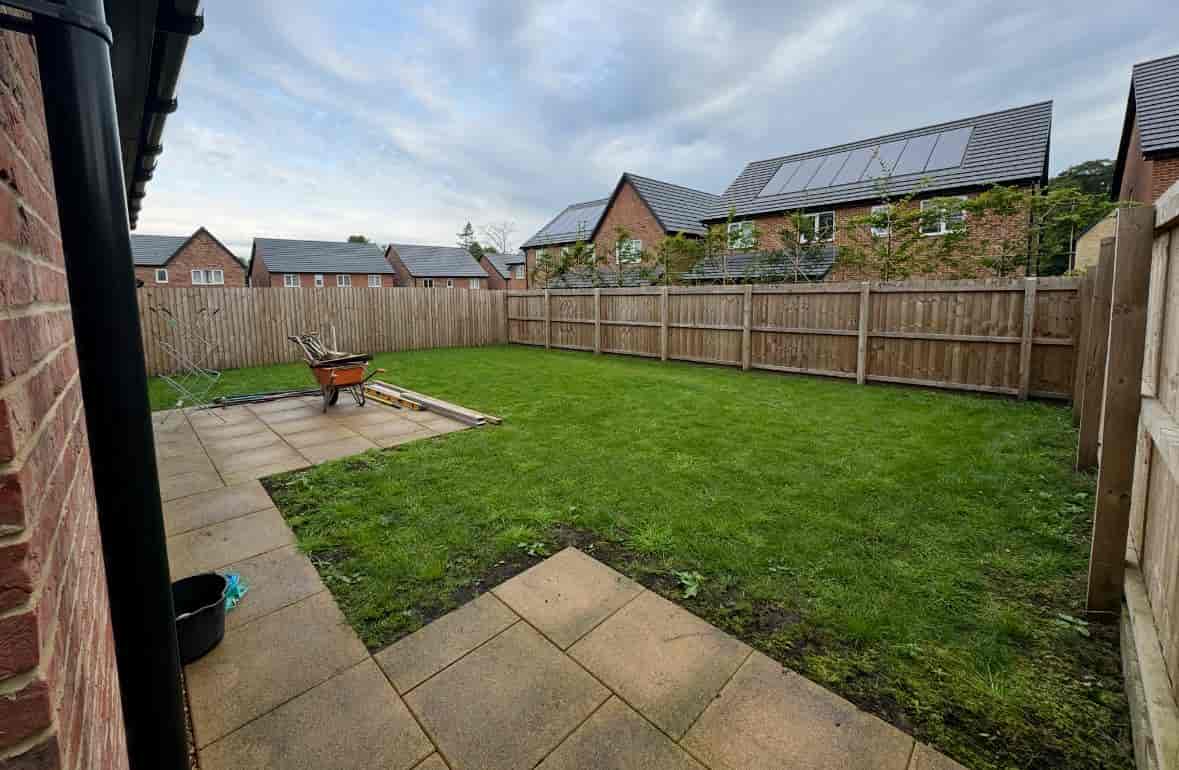 BEFORE
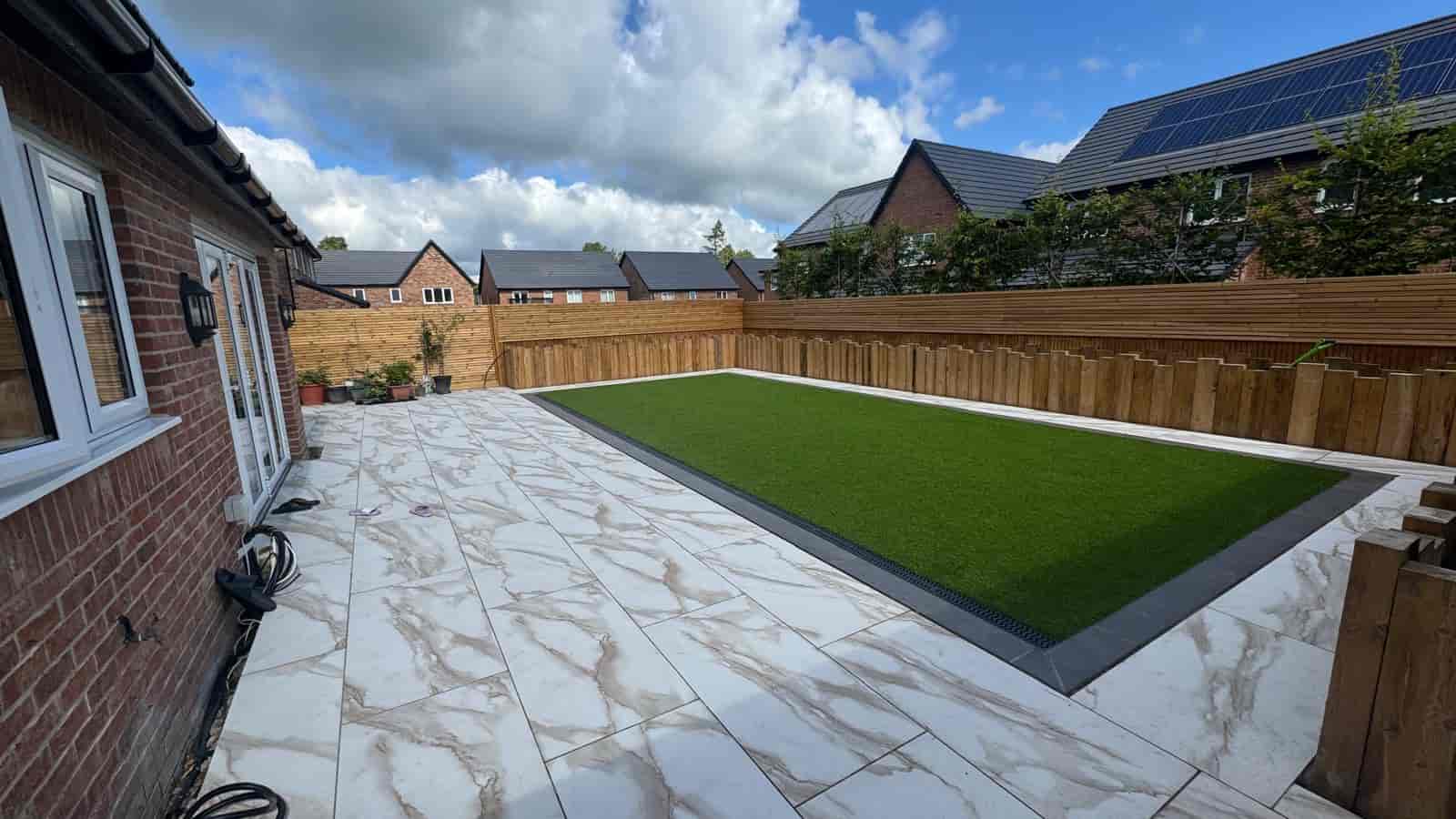 AFTER
These photographs show the same garden from different viewpoints. They show the finished result, not the hidden layer specification.
05 / GET THE PREPARATION RIGHT
What should happen
before the turf arrives?
Agree the preparation, finished levels and drainage approach before choosing quantities. A fixed excavation depth copied from another garden can miss what your site needs.
- 01
Assess the site
Look at access, existing surfaces, soft areas, nearby thresholds and what happens after rain.
- 02
Agree the build-up
Specify excavation, edging, drainage, aggregate and any membrane or underlay.
- 03
Build and check
Prepare and compact the layers to the agreed specification, checking support and finished levels.
- 04
Fit and finish
Install the turf, joins and fixings, then explain the care needed for the chosen system.
06 / DESIGN FOR DAILY USE
Who will use the lawn?
How the surface is used can change the preparation and product requirements. Tell your installer about more than the dimensions.
Dogs & family gardens
Discuss toilet areas, digging, cleaning and drainage. No backing material or infill makes a lawn permanently odour-free; installation and aftercare work together.
Schools & play areas
Share the equipment details and intended use. Where impact attenuation is needed, the whole surfacing system must suit the required performance. Ordinary comfort foam is not an equivalent.
Businesses & shared spaces
Allow for expected footfall, furniture, cleaning and access. Surface transitions and edges need to suit how people move through the space.
YOUR QUESTIONS, ANSWERED
Before you start
digging.
Some decisions can be explained in a guide. The final base specification needs to reflect the site.
Can you lay artificial grass directly on soil?
For a permanent garden lawn, laying turf straight onto untreated soil is unlikely to give a stable, even result. The ground needs preparation and a suitable supporting construction. A temporary covering is a different use and should not be treated as a permanent installation.
How deep should the base be?
There is no single depth for every lawn. Existing ground, intended use, drainage and finished levels affect the design. Ask for the excavation depth and the compacted thickness of each layer to be stated in the quote, alongside the reasons for that choice.
How much MOT Type 1 or other aggregate will I need?
Start with the agreed material and compacted depth. Area in square metres multiplied by depth in metres gives a geometric volume in cubic metres. A supplier then needs to allow for the material’s density, compaction and waste before converting that into an order quantity. Do not order by area alone.
Is MOT Type 1 always suitable under artificial grass?
No. It is used in some installation systems, but the appropriate aggregate depends on the site and drainage design. Where permeability through the sub-base is required, a suitable reduced-fines specification may be needed. Neither option replaces an assessment of the ground beneath it.
Do you need underlay on concrete or decking?
It depends on the existing surface, selected turf and intended use. A compatible underlay can have a useful role, but sound construction and a route for water to escape come first. It should not be used to conceal unstable slabs, rotten decking or an unresolved drainage fault.
Will a thicker base fix a waterlogged garden?
Not necessarily. Water still needs somewhere suitable to go. If the ground cannot accept it, the levels are wrong or an outlet is blocked, more aggregate alone may not solve the problem. Establish the cause before deciding on drainage work.
Can I reuse the base under an old artificial lawn?
Sometimes, if its condition and specification remain suitable. Check for movement, low spots, drainage problems, damaged edges and contamination. Replacing only the grass may leave an underlying problem untouched.
LET’S LOOK AT YOUR SPACE
Get the groundwork
right from the start.
Send your postcode, approximate dimensions and photos of the space. Tell us about puddles, changes in level, pets or play equipment so we can discuss the right next step.
Prefer to talk? 0161 207 3007
This guide explains the roles of the layers. For material specifications, see Holcim’s Type 3 aggregate information. Installation requirements also vary by turf system; Namgrass’s installation guidance is one manufacturer’s example, not an AGAG specification for every garden.