SOIL INSTALLATION • COST & GROUNDWORK
Laying artificial grass on soil means paying for a finished lawn and the ground beneath it—not simply rolling turf over the garden. As Good As Grass lists full installation at £45–£85 + VAT per m², equivalent to £54–£102 per m² including 20% VAT. The actual quote depends on excavation, access, drainage, the base, edging and your chosen grass.
This guide focuses on those soil-specific costs. For supply-only prices, product comparisons and the wider UK pricing picture, start with our master artificial grass cost guide.
How Much Does It Cost to Lay Artificial Grass on Soil?
Use the finished lawn area to establish a first budget, then check the site-specific work in the quote. Our published full-installation range includes groundwork, premium turf and fitting, with a 10-year warranty subject to its terms. Ask the team to confirm the scope and warranty conditions for your installation.
| Finished Lawn | Before VAT | Including 20% VAT |
|---|---|---|
| 20 m² | £900–£1,700 | £1,080–£2,040 |
| 30 m² | £1,350–£2,550 | £1,620–£3,060 |
| 40 m² | £1,800–£3,400 | £2,160–£4,080 |
| 60 m² | £2,700–£5,100 | £3,240–£6,120 |
These figures are area × £45–£85, with VAT added in the final column. They are not prices from completed jobs, and they do not imply that every garden can be installed at the bottom of the range.
Can You Save Money by Laying Artificial Grass Directly on Soil?
Not for a permanent garden installation we would recommend. Soil can move, soften and hold water. Covering it with turf does not create a stable foundation or solve an existing drainage problem.
The useful saving is avoiding unnecessary work after a proper assessment—not leaving out the work that keeps the surface stable. A low supply-only price is not comparable with a quote that includes excavation, waste removal, aggregates, edging and fitting.
What Makes a Soil Installation More or Less Expensive?
| Cost Driver | Why It Changes the Quote | What to Check |
|---|---|---|
| Excavation | The area and required dig depth determine how much material needs removing. | Is the depth based on finished levels and the proposed base build-up? |
| Waste and access | Soil, old turf and rubble need handling and disposal; narrow access can mean more manual work. | Are waste removal, skips and any access restrictions included? |
| Existing ground | Soft spots, made ground, roots or buried rubble may need extra preparation. | How will unexpected ground conditions be handled and priced? |
| Drainage | Slow-draining soil or existing standing water may require a separate drainage solution. | Where will water go, and what extra drainage work is included? |
| Base and laying course | Material selection, delivery and compaction depend on the site and intended use. | Which materials and compacted depths are proposed? |
| Edging and shape | Curves, steps, beds and long perimeters add fitting and finishing work. | Are all edges, transitions and fixings included? |
A soil garden is not automatically more expensive than every concrete installation. Removing unsuitable concrete can also be substantial work. Compare the actual preparation required rather than assuming one existing surface always gives the cheaper result.
A Useful Excavation Calculation
Area × excavation depth = the volume in the ground. For illustration, 40 m² × 0.075 m is 3 m³. That does not mean 75 mm is the correct depth for your garden, or that exactly 3 m³ of skip space will be enough: excavated material loosens and may include turf, stones or rubble.
Set the depth from the proposed finished levels and base design. Our artificial grass waste-removal guide explains the disposal side in more detail.
What Work Should a Soil-Installation Quote Cover?
You do not need to design the base yourself to compare quotations. You do need to know what each installer is proposing.
- Site assessment: measure the lawn, check access, inspect existing ground and identify drainage or level constraints.
- Excavation and disposal: remove unsuitable material to the depth required for the agreed build-up.
- Edging and separation: provide the perimeter support and any specified permeable geotextile in the correct position.
- Base construction: lay suitable aggregate, compact it in appropriate layers and form the planned falls.
- Final surface preparation: create a firm, even laying course without treating it as a way to hide a weak base.
- Grass and finishing: fit the turf, form joins, secure edges and apply any product-specified infill.
For the detailed preparation sequence, see how to prepare ground for artificial grass. Our step-by-step installation guide then covers fitting the lawn.
Three Garden Scenarios to Discuss With Your Installer
An Accessible, Straightforward Lawn
A reasonably shaped lawn with clear access, stable ground and no identified drainage problem may need a relatively straightforward build-up. Measure the finished area, but let the installer calculate roll requirements and cutting waste.
A Clay Garden With Persistent Puddles
The important question is why water collects and how it can leave the site. Extra excavation alone may not fix it. Ask for drainage work to be described separately so you understand what is being allowed for and what remains uncertain.
A Terraced Garden With Narrow Access
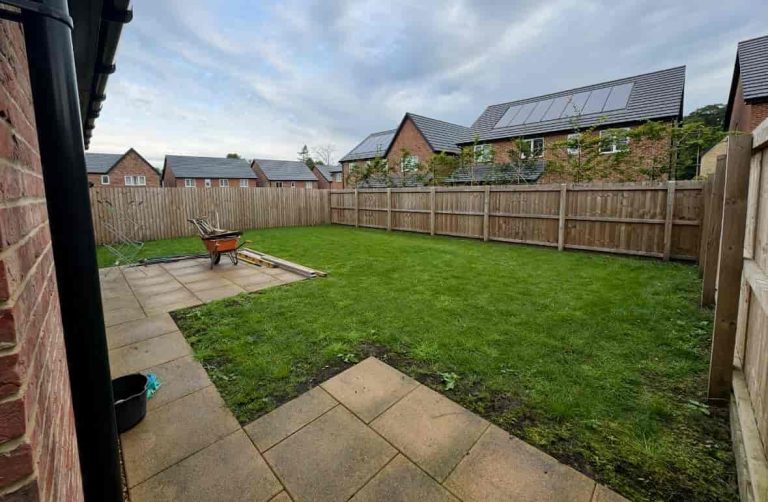
Where materials and waste must move through a narrow passage or restricted route, handling can become a significant part of the job. Send photographs of the access as well as the lawn; a garden-only photograph can miss the main pricing constraint.
These are planning scenarios, not quoted AGAG projects. They explain why equal-sized lawns can receive different prices without either quote being wrong.
Can You Prepare the Soil Yourself and Pay for Fitting?
Potentially—but agree the specification with the installer before starting. A base that looks smooth can still have inadequate compaction, incorrect levels or drainage problems. Paying to put it right can erase the expected saving.
Ask our team whether a preparation-and-fitting split is suitable for your project, what materials and levels are required, and how the prepared base will be checked. Do not assume a supply-only price includes labour, delivery or acceptance of an existing base.
For homeowners in Manchester and nearby areas, sharing clear photographs of access, boundaries and standing water helps us understand the groundwork before arranging the next step.
FAQs About Artificial Grass Installation on Soil
Does the £45–£85 per m² price include VAT?
No. AGAG’s published full-installation range is £45–£85 + VAT per m². At 20% VAT that becomes £54–£102 per m². The project quote confirms the final scope and price.
How much soil needs to be removed?
Enough to accommodate the specified base and turf while achieving the correct finished levels. There is no universal excavation depth for every soil, drainage condition and garden.
Is waste removal included?
Check the written scope. A proper comparison should identify excavation, handling and disposal, along with any skip or access-related allowances.
Does clay soil make the job more expensive?
It can if drainage or ground stability needs additional work, but clay alone does not determine a fixed surcharge. The site assessment should establish what is actually needed.
Can I use an existing gravel base?
Possibly, if its construction, condition, levels and drainage are suitable. It should be assessed rather than automatically retained or automatically removed.
Will I save money by buying the turf first?
Not necessarily. Roll widths, joins and cutting waste affect the order, and your installer needs to agree the product. Confirm the layout and fitting arrangement before buying.
Get a Quote That Includes the Ground Beneath the Lawn
Send us the approximate lawn size, a few garden photographs and a view of the access. Tell us about puddles, pets or planned changes to levels so we can discuss the right installation scope.
Updated 10 September 2026.