NATURAL TURF OR ARTIFICIAL GRASS?
A new lawn.
A clearer budget.
Returfing is usually cheaper upfront. A useful allowance for straightforward natural turf supplied and laid is £15–£30 per m² outside London and the South East. Our artificial grass installation guide uses £54–£102 per m² including VAT.
Those prices cover different work. One lawn needs soil that supports healthy roots; the other needs a constructed base and fitted turf. Compare the full job, then the upkeep that suits your household.
01 / YOUR STARTING BUDGET
What could your lawn cost?
Change the area to see the guide ranges side by side. These are starting allowances, not surveyed quotations.
For a rectangle, multiply length by width. Add separate sections together. This is the finished lawn area, not the roll order quantity.
Based on £15–£30/m², with VAT where applicable and basic preparation. Major clearance, soil improvement or drainage may be extra.
Based on £54–£102/m² for professional installation. Difficult access, unusual groundwork or drainage changes can take a project outside this range.
Price basis checked 4 November 2026: natural turf uses Fantastic Services’ published guide for outside London and the South East. Artificial grass uses our installation cost guide: £45–£85/m² plus 20% VAT. Calculations are area × guide rates; small-job minimum charges can affect the result.
See the 20, 40 and 100 m² examples
| Lawn area | Natural turf* | Artificial grass, inc. VAT |
|---|---|---|
| 20 m² | £300–£600 | £1,080–£2,040 |
| 40 m² | £600–£1,200 | £2,160–£4,080 |
| 100 m² | £1,500–£3,000 | £5,400–£10,200 |
* Natural turf includes VAT where applicable. Check clearance, soil preparation, access and drainage in each written quote.
JavaScript is off: the cards show a 40 m² example. Open the table for other sizes.
02 / UNDERSTAND THE WORK
How much does it cost to returf a lawn?
For a straightforward 40 m² lawn, the guide allowance is £600–£1,200. A full strip-out, significant levelling or drainage work needs its own assessment.
Ask whether the price is for turf laid on prepared ground or the complete replacement of your existing lawn. A low roll price does not include all the work needed to turn it into a garden-ready surface.
Simplified cross-sections, not construction specifications. Layer depths, materials and drainage arrangements depend on the site.
Why did the old lawn struggle?
Shade, compaction, repeated wear and poor drainage are different problems. Replacing the surface without addressing the cause can leave you paying twice. Artificial grass also needs drainage assessment; a permeable backing alone does not fix a waterlogged garden.
03 / NATURAL TURF
What does a returfing quote include?
Look for a clear scope from the old lawn coming up to the new turf establishing. Ask who handles each stage.
Removal & soil
Clearing the old surface, dealing with weeds or compaction, improving levels and adding suitable soil where needed.
Turf & fitting
The selected turf, delivery, laying, trimming and the agreed finish around paths and borders.
Water & aftercare
Instructions for keeping the turf appropriately moist and limiting use while roots establish. Allow for your time and water costs.
How do you returf a lawn?
- 1
Clear and assess
Remove the unwanted surface and identify drainage, shade or wear issues.
- 2
Prepare the soil
Correct the agreed problems, prepare the ground and settle the levels.
- 3
Lay fresh turf
Coordinate delivery with laying. Turf is a living product, so avoid leaving rolls stacked for longer than the supplier advises.
- 4
Help it establish
Follow the supplier’s watering and first-use advice. Adjust care to the season and conditions.
The RHS turf-laying guide explains preparation and establishment. It favours autumn to early spring when ground conditions are suitable; avoid working on frosty or excessively wet soil.
04 / ARTIFICIAL GRASS
What are you paying for?
The lawn you see is the finishing layer. Excavation, the foundation, edges and fitting are a large part of a professional installation.
A built foundation
The quote should explain excavation, waste removal, suitable aggregate layers, compaction and edging. Drainage design must consider both the surface and what happens to water beneath it.
A fixed depth or a deeper layer of stone is not a universal answer for wet ground. See our guide to what goes under artificial grass.
A fitted finish
Allow for the selected turf, the cutting plan, joins, edges, fixings and any system-specific infill. Curves and multiple separate areas can affect material use and labour.
For the work involved and a site-specific price, see our artificial grass installation service.
AN AGAG PROJECT / FULWOOD, PRESTON
Keep the lawn price separate from the wider garden.
This project included artificial grass, paving and defined borders. The full makeover and the lawn installation are different scopes to price.
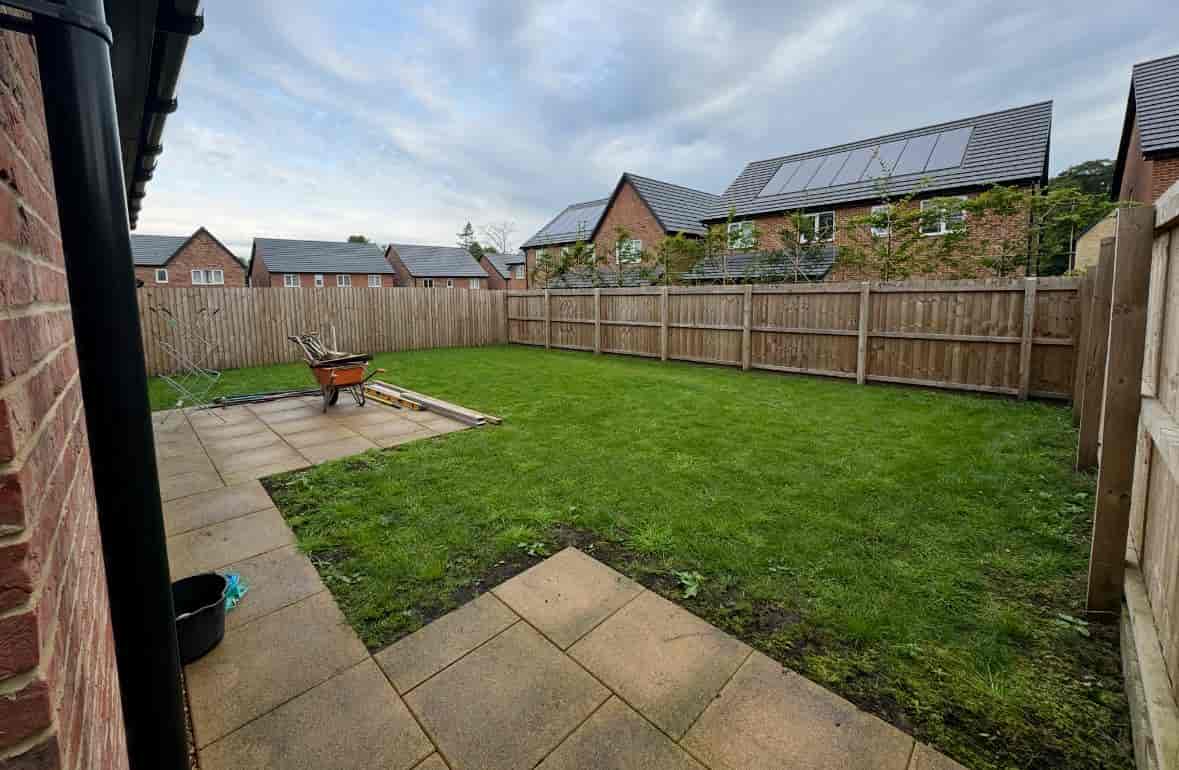 BEFORE
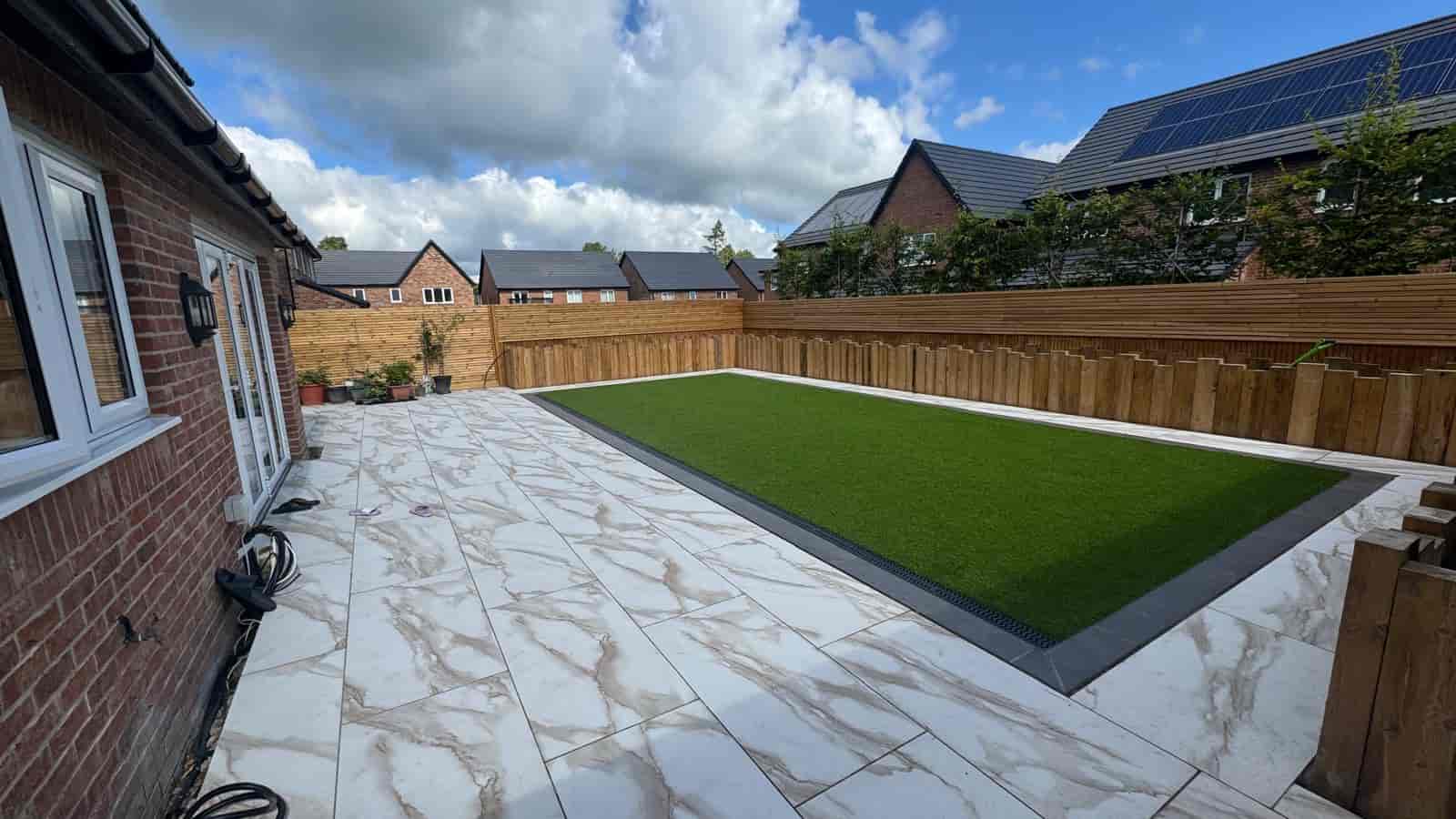 AFTER
These are real project photographs, not a priced example of the guide ranges. See our Preston installation service for local project context.
05 / COMPARE THE QUOTE, LINE BY LINE
What changes the final cost?
Use the same lawn area and finish when comparing quotes. Confirm what is included before adding separate allowances.
Old lawn & waste
What is coming out, how much material is leaving, and who pays for disposal? Avoid adding removal costs twice if they are already included.
Access & levels
Narrow passages, steps, slopes and long carrying distances affect the work. Photographs of the route into the garden help at enquiry stage.
Ground & drainage
Ask how the price deals with compaction, unstable ground or persistent puddles. Make any excluded remedial work explicit.
Extras & VAT
Separate paving, beds and other landscaping. Compare final payable totals and check the VAT treatment of every quote.
06 / THE DAY-TO-DAY DIFFERENCE
Artificial grass vs real turf
The lower invoice is only part of the decision. Think about the garden you want to use and the care you are willing to do.
| Consideration | Natural turf | Artificial grass |
|---|---|---|
| Routine care | Mowing and appropriate seasonal care; watering while new turf establishes. | Debris removal, brushing and cleaning. Pets can increase cleaning needs. |
| Wear & repairs | Worn patches can be repaired, reseeded or returfed. | Damaged seams, edges or fibres may need repair or replacement. |
| Ground conditions | Needs suitable soil, light and drainage for healthy growth. | Needs a stable base and drainage; it does not solve waterlogging by itself. |
| Feel & appearance | A living surface that changes with weather, season and use. | A consistent synthetic finish that can get hot in direct sun. |
| Living habitat | Grass and flowering lawn plants can provide food and habitat for wildlife. | Does not provide the living habitat of a planted lawn. |
For the wildlife value of natural lawns, see the RHS guide to lawn habitats. Keeping some planting in a garden is not the same as making the two lawn surfaces environmentally equivalent.
07 / PUT YOUR OWN NUMBERS IN
Which costs less over time?
Neither option is automatically cheaper over ten years. Compare your actual installation quotes, paid upkeep and repair or replacement allowances.
Use total prices including VAT where applicable. Enter 0 where you intend no cash allowance; a blank box means the comparison is incomplete.
Enter your figures, or try the labelled example.
| Cash allowance | Natural | Artificial |
|---|---|---|
| Installation | ||
| Care over the period | ||
| Repairs / renewal |
Method: installation + (annual care × years) + whole-period repairs/renewal. Prices stay constant: inflation, finance, resale value and the value of your own time are excluded. This is a cash-budget comparison, not a quotation, lifespan forecast or promise of savings. No details are submitted or stored by this tool.
JavaScript is off. You can use the formula above with your own figures and the checklist below.
Use the care you will actually pay for
Compare DIY care with DIY care, or paid services with paid services. Count equipment, suitable products, water and visits where relevant. An established natural lawn does not automatically need routine summer watering; care is different while new turf takes root. The RHS drought-care advice explains the distinction.
Allow for renewal honestly
A maintained natural lawn has no fixed replacement date. Artificial turf will eventually wear. Include any replacement you expect within your chosen period, and do not treat a warranty as a promise of zero upkeep.
CHANGING BACK?
Replacing artificial grass with real turf
This needs its own quotation. The straightforward returfing rate is not a price for removing and rebuilding an artificial lawn.
The work can include lifting the turf, removing or altering the aggregate base, restoring suitable soil and laying natural turf or seed. Check disposal, levels and drainage. New natural turf should not simply be laid onto a synthetic-lawn sub-base.
Our guide to replacing artificial grass with real grass explains the changeover in more detail.
08 / CHOOSE FOR YOUR GARDEN
Which option makes sense?
Start with the condition of your current lawn, then the surface and care routine you want to live with.
Is full replacement necessary?
If most of the lawn is sound, assess patch repairs or overseeding first. Deal with the cause of repeated damage before buying a whole new surface.
A living lawn
Consider returfing where growing conditions are suitable and you are happy with mowing and seasonal care. It usually has the lower initial cost.
A lawn without mowing
Consider artificial grass if a consistent finish and avoiding mowing are priorities. Budget for brushing and cleaning, and discuss drainage and summer heat.
QUICK ANSWERS
Lawn replacement FAQs
Practical answers before you request a quotation.
How much does it cost to returf a garden?
For straightforward natural turf supplied and laid outside London and the South East, £15–£30 per m² is a useful guide allowance. That gives £600–£1,200 for 40 m². Confirm clearance, soil work, access, drainage and VAT in the actual quote.
What is the cheapest way to replace a lawn?
If much of the existing lawn is healthy, repair or overseeding may be enough. Where full replacement is needed, natural turf usually costs less upfront than professionally installed artificial grass. Preparation and site condition still affect the total.
Is artificial grass worth the extra cost?
It can be worthwhile if avoiding mowing and having a consistent synthetic finish suit how you use the garden. Compare the installation, care and renewal costs with your own priorities. It is not a guaranteed financial saving.
Does returfing include removing the old lawn?
Sometimes, but do not assume it does. Ask whether the price covers old-lawn removal, unwanted soil, waste disposal and preparation, or only turf supplied and laid on ground that is already ready.
Can I replace my lawn myself?
You can, if you have the tools, time and knowledge for the preparation. Natural turf and artificial grass need different ground construction. Include tool hire, delivery, waste removal and materials when comparing DIY costs.
How long does real turf last?
A natural lawn can continue with appropriate care and repair; it does not have a fixed replacement date. Soil, light, drainage, wear and maintenance determine its condition.
Can artificial grass go on concrete?
It may suit a sound existing surface, depending on its condition, drainage and the fitting system. Have it assessed and priced separately rather than applying a soil-based installation budget.
Does artificial grass need maintenance?
Yes. It needs debris removal, brushing and suitable cleaning, particularly where pets use it. Worn turf, damaged joins or edges may also need repair. Include care and eventual renewal in your budget.
GET A PRICE FOR YOUR ACTUAL GARDEN
Ready to explore an artificial lawn?
Send us the lawn dimensions, photographs and access details. Our team can assess the groundwork and explain the installation price for your site.
Request an artificial grass quote
Tell us about puddles, pets and any wider garden work you are planning.
- Approximate lawn area and location.
- Photos of the lawn and access route.
- Any drainage or uneven-ground concerns.
- Your priorities, budget and timescale.
Prices are dated guide allowances with sources above. Final scope and cost require written quotations. The calculators explain the arithmetic; they do not assess your ground, specify an installation or predict a surface’s service life.